

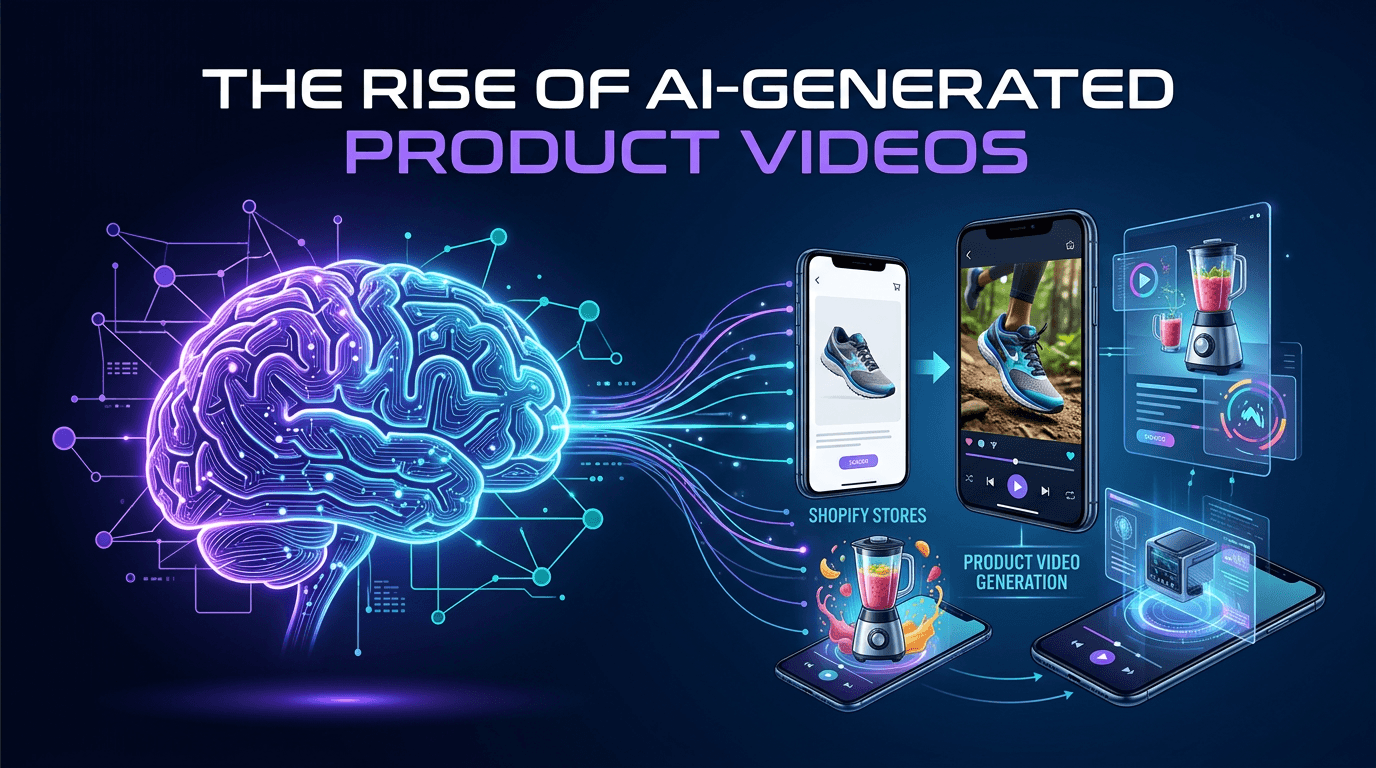
The Rise of AI-Generated Product Videos: What It Means for Shopify Stores in 2026
AI video tools can now create product demos from a URL. Here's how AI is reshaping video commerce for Shopify merchants.
In 2024, creating a product video meant hiring a videographer, booking a shoot, and waiting days for edits. In 2026, you paste a product URL and get a polished demo in minutes. That's not hyperbole — it's the current state of AI video generation for e-commerce.
The AI-enabled e-commerce market has reached $8.65 billion in 2026 and is projected to hit $64 billion by 2034. Within that explosion, AI video is one of the fastest-moving categories — and for Shopify merchants, it's solving the single biggest barrier to video commerce: content production at scale.
Here's what's happening, what tools are leading the charge, and how to think about AI video as part of your broader content strategy.
The Content Bottleneck Every Shopify Merchant Faces
The data on video commerce is unambiguous. Product pages with video see 47% higher engagement. Shoppable videos can deliver 8.5–9x conversion lifts. Video testimonials retain 95% of their message compared to 10% for text.
The problem was never awareness — merchants know video works. The problem was production. Traditional video creation costs $200–$500+ per product video when you factor in filming, editing, and post-production. For a store with 100 SKUs, that's a $20,000–$50,000 investment before a single view is generated. For stores with thousands of SKUs, manual video production is simply impossible.
AI video generation changes this equation entirely. Tools now reduce per-video costs by up to 90%, making a "video for every SKU" strategy feasible for the first time.
How AI Video Generation Works
Modern AI video tools for e-commerce operate through several approaches:
URL-to-Video
The simplest workflow: paste a product page URL, and the AI extracts images, descriptions, and specifications to generate a video automatically. The tool selects appropriate transitions, adds text overlays highlighting key features, and outputs a ready-to-publish product demo. Some tools can produce 50+ videos in the time it takes to brief a traditional editor on a single project.
Image-to-Video
Upload product photos and the AI animates them — adding camera movement, zoom effects, lifestyle backgrounds, and dynamic transitions. This is particularly effective for stores that have good product photography but haven't made the leap to video. The 2025 generation of models (like Google's Veo 2, Kling 2.0, and Runway Gen-3) produce remarkably stable output with consistent product appearance across frames.
AI-Powered Product Staging
The newest category: AI tools that generate entirely new product visuals — different backgrounds, lifestyle contexts, even virtual try-on experiences — then assemble them into video. Tolstoy, one of the leading Shopify apps in this space with over 9,500 installs, now brands itself as "AI Photoshoots" and can generate both photos and videos from product data.
Top AI Video Tools for Shopify in 2026
The Shopify ecosystem has rapidly adopted AI video capabilities. Here's what the leading tools offer:
- Tolstoy: Full AI studio for catalog-scale image and video generation, plus AI-powered sales chat and virtual try-on. The only platform that generates AI visuals and publishes them directly into shoppable feeds. (9,500+ Shopify installs)
- Videowise: UGC discovery and shoppable video creation with advanced analytics. Strong for teams that need performance insights alongside content tools. (2,000+ installs)
- Firework: Short-form video stories with omnichannel embedding and live commerce capabilities.
- ReelTok: AI-powered video creation from product URLs, with shoppable stories, carousels, and floating reels designed for zero-code Shopify integration.
The competitive landscape is moving fast. Shopify itself has integrated AI across its platform — from Shopify Magic for generating product content to AI-generated store sections and Sidekick AI for store management.
AI-Generated vs. Human-Created: What Converts Better?
This is the critical question, and the answer is nuanced. A landmark study with Swiss retailer Migros showed that AI-enhanced product content drove a 23.7% increase in conversion rates. Wayfair used generative AI to refresh descriptions for thousands of items, achieving a 68% reduction in content production time.
But here's what the data also shows: the highest-converting video content is still authentic. The State of Video Commerce report found that employee-generated content converts at 9x the industry average, and user-generated content makes up 36% of top-performing shoppable videos.
The takeaway isn't AI or authentic — it's AI and authentic. The most effective video strategy in 2026 uses AI for scale and human content for trust:
- AI video for: product demos, feature highlights, catalog-scale coverage, ad creative variations, seasonal refreshes
- Human video for: customer testimonials, employee demos, unboxings, behind-the-scenes, founder stories
AI gets you to "video on every product page." Human content gets you to "video that converts at 9x."
The "Video for Every SKU" Strategy
For the first time, Shopify merchants can realistically aim for complete video coverage of their catalog. Here's how to approach it:
Tier 1: Top Sellers (Human + AI)
Your top 20% of products by revenue deserve the highest-quality video treatment. Combine AI-generated product demos with authentic content — customer reviews, employee picks, founder stories. These pages should have multiple video types: a polished demo, a UGC testimonial, and a shoppable reel.
Tier 2: Mid-Catalog (AI-Generated)
Products that sell steadily but don't justify custom video production. Use URL-to-video AI tools to generate clean product demos at scale. Even a basic AI-generated video outperforms a static product page — remember, 64% of consumers are more likely to buy after watching a product video.
Tier 3: Long Tail (Automated)
For low-traffic or seasonal products, fully automated video generation from product images and descriptions provides basic coverage. The goal isn't viral content — it's ensuring no product page is entirely static.
How to Blend AI and Authentic Content
The merchants who will win at video commerce in 2026 aren't choosing between AI and authenticity. They're using each where it makes the most impact:
- Start with AI for coverage: Generate product demos for your entire catalog so every product page has video. This is your baseline.
- Layer in UGC and EGC: Collect customer and employee videos for your best sellers. Place these alongside AI-generated content for maximum social proof.
- Make everything shoppable: Tag products in every video — AI-generated or human-created — so viewers can buy without friction.
- Test and refresh: AI makes it cheap to experiment. Generate multiple versions of a product demo, test them against each other, and keep the winner. Refresh seasonal creative in hours instead of weeks.
As Shopify reports, companies leveraging AI see an average revenue increase of 10–12% and conversion rate lifts up to 10% from automating high-quality product content. When you combine that with the 8.5–9x lift from authentic shoppable video, the compounding effect is significant.
The Future Is Blended
AI video generation has crossed the threshold from experimental to essential. The cost and time barriers that kept most Shopify merchants from adopting video commerce have been eliminated. But technology alone doesn't build trust — people do.
The winning formula in 2026: AI for scale, authenticity for conversion, and shoppable formatting for both.
ReelTok brings this together — AI-powered video creation from your product URLs, combined with easy import of your UGC and social content, published as shoppable stories and reels across your store. No code, no speed impact, no production budget required. Start your free trial and build a video-first store.
Related articles
More from AI & Personalization

Your Shopify Store Can Now Hand Its Cart to an AI Agent: What WebMCP Changes
Shopify quietly turned on WebMCP for every Liquid storefront in August 2026, letting browser AI agents search, cart, and checkout directly. Here's what to verify.

Shopify Is Building for Agentic Commerce: Is Your Product Data Ready for AI Shopping Agents?
Shopify Catalog now feeds product data to ChatGPT, Copilot, and Gemini automatically. Here's what merchants need to fix before AI agents recommend a competitor instead.

New York's AI Disclosure Law Is Live: What It Means for AI-Generated Product Videos
New York now requires disclosure of AI-generated synthetic performers in ads. Here's what Shopify merchants using AI video need to know.