


The AI Creator Economy Is Booming: What It Means for Your UGC Strategy
UGC creator collaborations are up 93% year over year, and most brands now use AI somewhere in the pipeline. Here's how to use both without losing trust.
The number of UGC creators working with brands surged 93% year over year, according to Collabstr's latest influencer marketing report, and UGC-style collaborations now make up 15% of all influencer partnerships. At the same time, nearly three in four brands are already using AI, or plan to within the year, for creator marketing tasks, according to IAB's 2025 Creator Economy Ad Spend and Strategy Report. Roughly a third are using AI to generate synthetic content outright.
Two things are true at once here: demand for authentic, person-to-person UGC has never been higher, and the tools to fake it convincingly have never been more accessible. That combination is reshaping what "UGC strategy" actually means for a Shopify store in 2026, and it's worth separating the trend from the risk before you build your content plan around either one.
Why the Demand for Real UGC Keeps Climbing
Gen Z now spends 54% more time watching user-generated content than the average consumer, and 26% less time watching traditional TV and movies. Sprout Social's Q2 2025 Pulse Survey found that almost half of Gen Z shoppers now turn to social media first when researching a product, ahead of search engines. UGC that lives on social platforms is functioning as a search result in its own right. And 82% of consumers say they're more likely to buy from a brand that features real UGC in its marketing, per Backlinko.
None of that is new in direction, but the scale is. Paid UGC creator activity nearly doubled year over year, which means the supply of people willing to make branded content professionally has grown faster than most brands' ability to source, vet, and manage it manually.
Where AI Is Actually Being Used
The IAB data breaks down what "AI for creator marketing" means in practice, and it's less about replacing creators and more about the workflow around them: editing and personalizing content (used by nearly half of brands), vetting creators, mining campaign performance data, and automating repetitive production steps. Generating fully synthetic content, an AI avatar standing in for a real customer, is the smallest of these use cases, but it's the one that carries the most reputational risk if handled carelessly.
There's a real, useful distinction between AI-assisted UGC and AI-generated UGC pretending to be organic. Using AI to caption, edit, or repurpose a real customer's video is production efficiency. Presenting an AI avatar as though it's a genuine customer testimonial is a different thing entirely, and increasingly a legally risky one; disclosure requirements for synthetic performers in advertising are already law in some states and tightening elsewhere.
The Two-Layer Strategy That Actually Works
The brands getting this right aren't choosing between real UGC and AI content. They're using each for what it does best, clearly labeled, in the right place on the customer journey. AI-generated brand content, product demos, staged b-roll, avatar walkthroughs, answers "what is this and does it look credible?" the moment a shopper lands. Real customer UGC answers "did it actually work for someone like me?" at the point they're deciding whether to buy. We've written before about exactly how to structure that split across your homepage, product pages, and collection pages.
The mistake to avoid is letting AI content quietly replace real UGC everywhere, rather than filling the specific gaps where real customer footage doesn't exist yet: new products with no reviews, lower-traffic SKUs, or launch windows before customers have had time to create anything. AI content that's honestly used to fill those gaps, and clearly not passed off as a customer testimonial, keeps the trust benefit of UGC intact. AI content that blurs the line erodes it for your entire store, not just the one video.
Practical Guardrails for 2026
- Never present an AI avatar as a specific real customer. Fictional presenter, clearly framed as a product demo or brand video, not a testimonial.
- Keep real customer video as your primary trust signal on high-traffic, high-consideration products. That's where the credibility gap matters most.
- Use AI content to solve the cold-start problem. New launches, low-volume SKUs, and seasonal drops rarely have organic UGC yet. AI-generated demos fill that gap without waiting weeks for customers to create content.
- Keep the two visually distinguishable in your own internal workflow, even if the on-page experience is seamless, so you always know which asset is which when disclosure questions come up.
Building the Strategy on Your Own Store
Wherever your UGC comes from, real customer footage or AI-generated brand content, it only works as a conversion tool if it's placed where the shopper is actually deciding to buy, not buried in a separate reviews tab or left to compete in a social feed you don't control. ReelTok lets you import real customer video directly from TikTok and Instagram, generate AI product demos and avatar walkthroughs through the built-in Studio, and place both as shoppable Stories, Carousels, and Floating Reels anywhere on your store, tagged to the exact product being shown.
The creator economy is scaling faster than most brands' content pipelines can keep up with, and AI is genuinely useful for closing that gap. The brands that win the trust of Gen Z shoppers watching 54% more UGC than anyone else won't be the ones who pick a side. They'll be the ones who use both, honestly, in the right place. Try ReelTok free and build that mix on your own product pages in five minutes.
Related articles
More from UGC & Social Proof

Stop Building on Borrowed Ground: Why Shopify Stores Need to Own Their Brand Story in 2026
Facebook organic reach is under 2%. Meta is demoting non-original content. Here's why your Shopify store should tell your brand story.
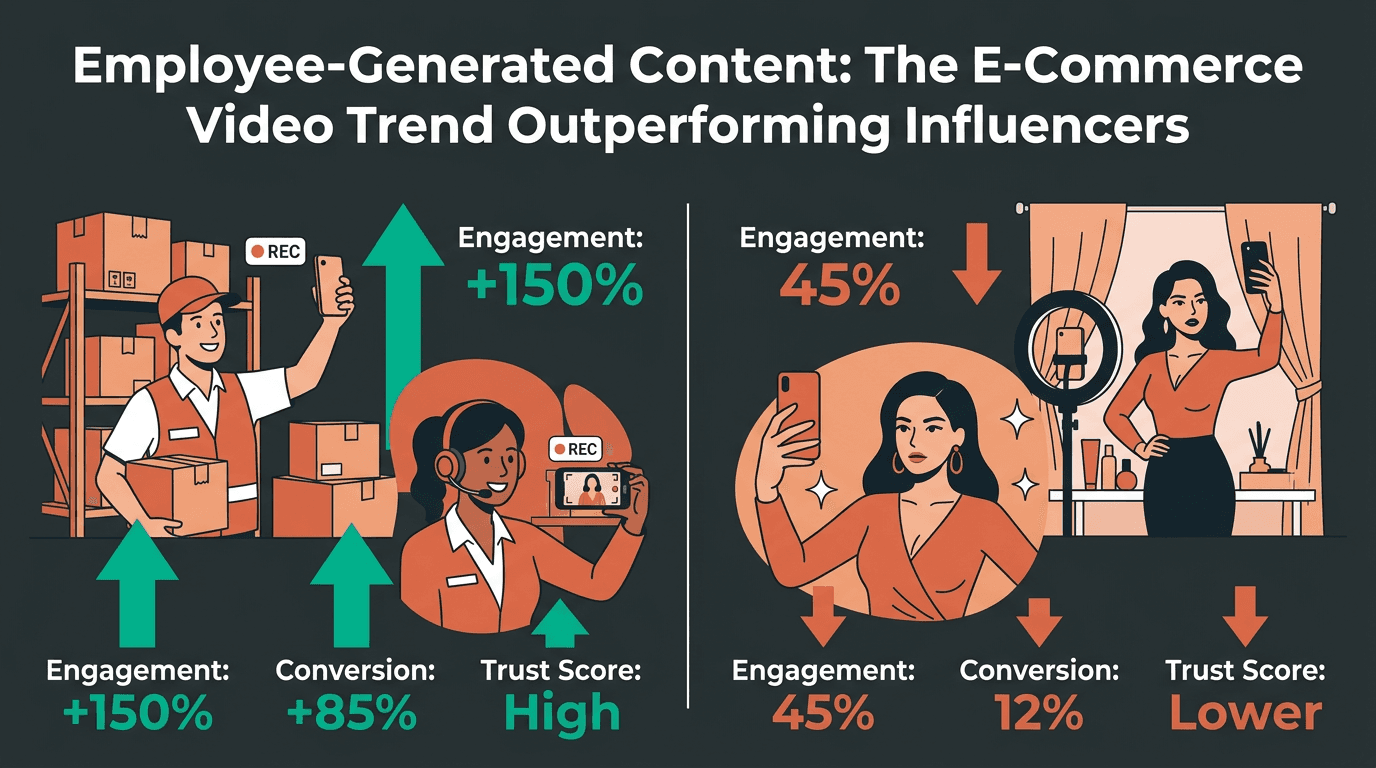
Employee-Generated Content: The E-Commerce Video Trend Outperforming Influencers
EGC videos hit a 20% conversion rate — 9x the industry average. Here's why employees are your store's best content weapon.
The Ultimate Guide to Partnering with Influencers through Shopify Collabs
Learn how to partner with influencers through Shopify Collabs to boost your brand and explore career opportunities at Shopify.