

Meta's Worst Week: What the Landmark Court Rulings Mean for E-Commerce Brands
Meta lost two landmark court cases in one week and faces an FTC appeal. Here's what Shopify store owners need to know about platform risk.
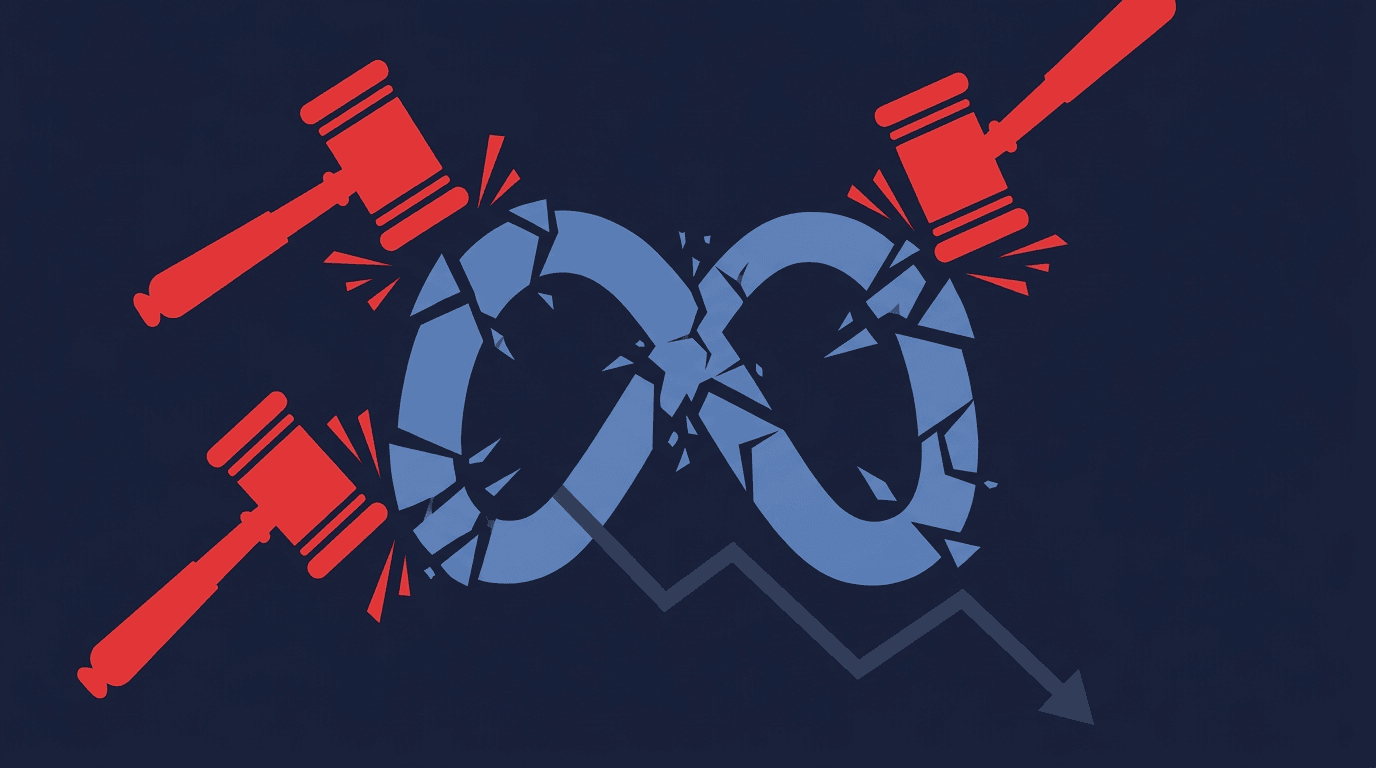
The last week of March 2026 will be remembered as a turning point for Meta. In the span of just a few days, the Facebook and Instagram parent company was hit with two landmark jury verdicts and saw the FTC double down on its antitrust fight — all while its stock posted the worst performance among the Magnificent Seven over the past year. If your Shopify store relies on Meta's platforms for visibility, traffic, or sales, this is the moment to pay attention.
Three Court Losses in One Week
New Mexico: $375 Million for Endangering Children
On March 25, a New Mexico jury found that Meta violated the state's Unfair Practices Act by misleading users about the safety of Facebook, Instagram, and WhatsApp — and by failing to protect children from sexual exploitation on its platforms. The seven-week trial, brought by state prosecutors after an undercover investigation, ended with a $375 million verdict.
New Mexico Attorney General Raúl Torrez called it "a historic victory for every child and family who has paid the price for Meta's choice to put profits over kids' safety." Prosecutors argued that Meta executives knew their products harmed children, disregarded warnings from their own employees, and lied to the public about what they knew.
California: $6 Million — and 2,000 Lawsuits Waiting
Just one day later, a California jury found Meta and Google liable for harming a woman's mental health because of addictive design features on their platforms. The $6 million verdict might sound small — but the case is a test trial tied to approximately 2,000 pending lawsuits making similar claims. If those cases follow the same pattern, the financial and operational consequences for Meta could be enormous.
During the trial, Meta founder Mark Zuckerberg testified that the company was "building this thing to be a good thing that has value in people's lives." The jury disagreed.
FTC Antitrust Appeal: The Breakup Threat Lives On
Meanwhile, the Federal Trade Commission is appealing a November ruling that had gone in Meta's favor in the long-running antitrust case. The FTC originally sued in 2020, alleging that Meta orchestrated a social media monopoly by acquiring Instagram in 2012 and WhatsApp in 2014. While a federal judge ruled that those acquisitions didn't violate antitrust law, the FTC's appeal keeps the possibility of a forced breakup on the table.
The antitrust trial itself made history: it was the first time field experiments played a central role in a major federal antitrust case, according to the economists who testified on Meta's behalf. Legal scholars are already questioning whether Meta's winning argument — that Facebook competes with "literally anything else" for users' time, including sleep — will hold up on appeal.
Wall Street Reacts
Investors noticed. According to Forbes, Meta shares dropped 7.96% on Thursday and another 4.3% on Friday, following the back-to-back verdicts. Over the past year, Meta stock is down 19.4% — the worst performer among the "Magnificent Seven" tech stocks.
The selloff wasn't driven by court losses alone. Forbes cites compounding factors: delays in Meta's next-generation AI model, the continued decline of its metaverse division (Reality Labs lost $6 billion in Q4 2025 alone), and growing investor skepticism about the company's $115–135 billion capital expenditure plan for 2026.
For businesses that depend on Meta's platforms, the stock price isn't the point. The point is what it signals: a company under pressure from multiple directions at once, which historically leads to unpredictable product changes, cost-cutting, and shifting priorities.
What This Means for Shopify Stores
If you run a Shopify store and use Facebook or Instagram for marketing, advertising, or brand building, these rulings create three concrete risks:
1. Platform Redesigns Forced by Court Orders
The New Mexico verdict specifically targeted addictive design features and child safety failures. If similar verdicts follow in the 2,000+ pending cases, Meta may be forced to fundamentally redesign how its platforms work — changing feed algorithms, limiting engagement mechanics, or restricting how content reaches younger demographics. Any of those changes could disrupt the advertising and organic strategies your store depends on.
2. Regulatory Uncertainty
With the FTC appeal alive, there's a non-zero chance that Meta could eventually be forced to divest Instagram or WhatsApp. Even if that doesn't happen, the regulatory pressure is already shaping Meta's priorities. The company is spending more on compliance, legal defense, and safety infrastructure — resources that aren't going toward the commerce and advertising tools merchants rely on.
3. A Platform That's Optimizing for Its Own Survival
Meta's Q4 2025 earnings call made one thing clear: the company's top priority is AI infrastructure and recommendation systems, not small business tools. Zuckerberg told investors he's "looking forward to advancing personal superintelligence" in 2026, while the company plans to spend up to $135 billion on AI infrastructure. The platform is evolving to serve Meta's goals — and those goals are increasingly divergent from the needs of the average Shopify merchant.
The Bigger Picture
These court rulings are dramatic, but they're symptoms of a deeper problem for businesses that build on Meta's platforms. Even before this week, Facebook's algorithm had been quietly making it harder for business pages to reach their own followers. Organic reach has collapsed from 16% in 2012 to under 2% in 2025. Meta formally announced on March 16 that it would demote non-original content and penalize accounts that rely on reposting. And the company is even testing limits on how many links business pages can share without paying for Meta Verified.
The legal turmoil accelerates an existing trend: Meta's platforms are becoming less reliable, less predictable, and less aligned with e-commerce interests. The businesses that will thrive aren't the ones hoping this blows over — they're the ones building their brand story and social proof on channels they actually control.
In our next post, we break down exactly how to make that shift — including the data behind why your own Shopify store is the most powerful (and underused) brand-building channel you have.
Related articles
More from Market Trends

TikTok Shop's $23 Billion Year: What It Means for Your On-Site Video Strategy
TikTok Shop is on pace for $23.4B in US sales in 2026. Here's what that growth actually means for Shopify merchants who don't sell there.

Tariffs Are Reshaping E-Commerce: The Brands That Tell Their Story Will Win
The de minimis exemption is gone. Tariffs are spiking landed costs. The Shopify brands that survive are the ones justifying their price with story.